How to Interview Recent Graduates: 6 Must-Know Rules
- Guest Author
- March 29, 2018
Interviewing recent graduates: pros and cons
The trouble with interviewing recent graduates
6 must-know rules for interviewing graduates
Rule #1: Provide a clear directive
Rule #2: Use follow-up questions
Rule #3: Investigate their organization and time management skills
Rule #4: Ask about their problem-solving skills
Rule #5: Do not judge their communication skills too fast
Rule #6: Assess their motivation
How to provide the best interview experience for recent graduates?
About the author
Applicant Tracking, Recruitment Marketing, Sourcing and Talent CRM software are powerful alone, but unstoppable when used together!
How to interview recent graduates? Because of their lack of experience, you can’t rely on their job skills, job history or recommendations. This blog post presents 6 must-know rules for interviewing recent graduates that will help you see their potential.
Interviewing recent graduates: pros and cons
Do you want to add some fresh perspective to your workplace, but are struggling to choose the right candidate?
Selecting recent graduates is challenging for the interviewer since you cannot rely on a job history or recommendations from previous employers.
And yet, many of these candidates are the brightest minds and exactly what you need for your company. They are ambitious, tech-savvy, up to date with recent trends and industry best practices and less expensive to hire.
If you do not want to miss out on such an excellent opportunity, you should try and see their potential through other methods.
➡️ Download The Ultimate Candidate Interview & Employee Onboarding Checklist!
The trouble with interviewing recent graduates
A recent graduate is not your traditional candidate, and you will literally have no written proof of their job skills because of their lack of real work experience.
➡️ What can you do?
‘’The young age and lack of work experience do not make a candidate less worthy of a position, so do not be so quick to judge them. In many cases, recent graduates won’t even have the experience with interviews, so you will find it much harder to discern their qualities and skills. You need to learn to see through these issues and select the right one for the job.‘’– advises Jill Julian, HR manager at aussiewritings.com.
Harder does not equal impossible. When interviewing recent graduates, successful recruiters rely on 6 must know rules.
6 must-know rules for interviewing graduates
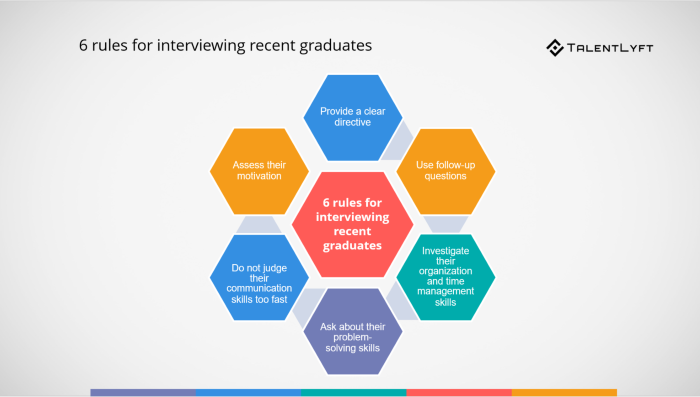
Here is what you need to keep in mind when interviewing a recent graduate:
Rule #1: Provide a clear directive
As an interviewer to novice candidates for their first job, you need to assist them during the interview. To make things easier for both of you, provide novice candidates with a clear directive.
This directive will depend on your approach and job description for a position you are looking to fill and specific interview questions. Tell the candidate how they should respond to your interview questions.
“When I ask you the questions, provide me with examples from previous experience or things you have learned in class. Try to be specific and tell me about the results.”
Rule #2: Use follow-up questions
The candidate may be confused and very anxious during their interview, since they don’t have that much experience in being in such situations. Be prepared for some incomplete or vague answers.
Do not get annoyed when this happens. Instead of asking the candidate to repeat the answer or tell them their answer was bad, give them a second chance by using a follow-up question.
“I see… Now tell me a bit more about what you did and when you did it. What exactly happened during that project?’’
Rule #3: Investigate their organization and time management skills
Organization and time management are key for successful projects. If your employee has the knowledge to do something but lacks the skills to organize their time and activities, they are not the right person for the job.
To investigate this, ask them some general questions about their life. This should help you understand how organized they are, and how they prioritize their daily tasks.
“Tell me how you organize an ordinary day, starting from the morning till you go to sleep. If you want, you can talk about the days when you were at school.’’
Rule #4: Ask about their problem-solving skills
When asking about candidates’ problem-solving skills, you should use specific problem-solving interview questions. Some work experience can come very handy when you are using problem-solving skills. But, even if they do not have work experience, you can focus on their volunteering or internship experience, as well as academic projects that require this skill.
‘’Have you ever found yourself in a situation where you had to act fast and solve an unexpected problem? What were your responsibilities and decisions in that particular moment? What was the outcome of your actions?’’
Rule #5: Do not judge their communication skills too fast
A recent graduate can have excellent communication skills, but feel too frustrated and afraid during the interview. Try to assess their communication skills using specific communication skills interview questions somewhere at the end of the interview, after the candidate is relieved from the initial stress and can express himself/herself without troubles.
Pay attention to the details. Does the candidate respond to your questions without taking the time to think? Does a candidate need a lot of time to process the question? What kind of language does the candidate use while talking to you?
Rule #6: Assess their motivation
No matter how amazing the academic performance of a candidate is, he won’t be much of use for your company if he is not motivated to work for you.
Try to see how motivated a candidate is. A motivated graduate will learn what he does not know faster and use his skills fully to finish the job.
“What do you most enjoy doing? When you are not studying, what do you do in your spare time? Why do you want to work here?”
These answers should tell you what you need to know about the candidate’s values, qualities and contribution to your company.
How to provide the best interview experience for recent graduates?
When interviewing recent graduates, keep in mind that even those that you don’t end up hiring at the moment can become top experts in the future. That is why it would be a smart decision to keep them in your talent pool .
In order to do so, you should learn how to say “Sorry, you didn’t get the job” in a way that will ensure that you maintain a strong Employer Brand, keep candidates in your talent pool and improve your candidate experience.
About the author
Olivia is a passionate blogger who writes on topics of digital marketing, career, and self-development. She constantly tries to learn something new and share this experience on various websites. Connect with her on Facebook and Twitter.
Applicant Tracking, Recruitment Marketing, Sourcing and Talent CRM software are powerful alone, but unstoppable when used together!


