What Can You Learn from Candidate’s Body Language?
- Anja Zojceska
- April 6, 2018
The importance of the candidate’s body language
What is body language?
What can you really tell from the candidate’s body language?
Guidelines for reading candidate’s body language
Guideline #1: Read the candidate’s gestures in clusters
Guideline #2: Interpret the candidate’s gestures in context
Guideline #3: Look for (in)congruence
Guideline #4: Pay attention to the sequence
Guideline #5: Keep in the mind candidate’s cultural background
Guideline #6: Consider the job requirements
Tips and tricks for reading candidate’s body language
How to spot a liar?
How to recognize a fake smile?
How to deal with a “professional” interviewee?
Recruiters, beware: Your body sends signals as well!
How to become an expert in reading a candidate’s body language?
Step #1: Study
Step #2: Practice
Applicant Tracking, Recruitment Marketing, Sourcing and Talent CRM software are powerful alone, but unstoppable when used together!
Ability to read candidate’s body language is an invaluable skill for recruiters. If you learn how to read your candidates’ body language, you will be able to find out more about them and make better hiring decisions.
The importance of the candidate’s body language
How long does it take you to know if a candidate is a good fit for the position?
When asked about it, more than half (51%) of employers say that they know within the first 5 minutes of an interview if a candidate is a good fit for a position.
Research shows it takes even less – 20 seconds to be exact.
Judgments made in the first 20 seconds of an interview could predict the outcome of the interview.
This means that candidates’ destinies are determined solely by the way they enter the room and greet an interviewer, without even answering a single interview question.
Albert Mehrabian, a pioneer researcher of body language in the 1950’s, found that the total impact of a message is about 55% nonverbal (body language), 38% vocal (including tone of voice, inflection, and other sounds) and only 7% verbal (words).
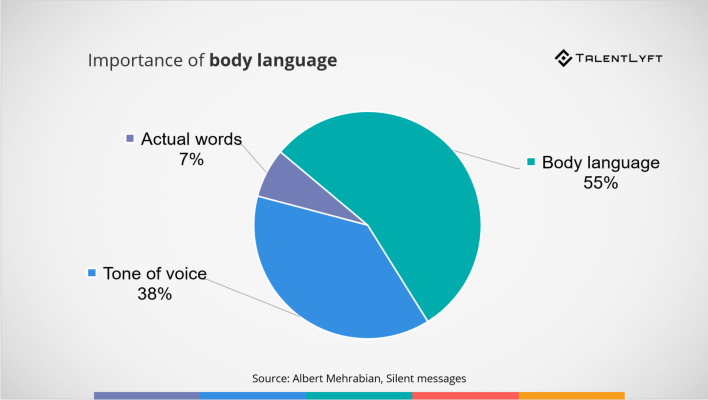
Many other studies give us further convincing evidence that a candidate’s approach, handshake and overall body language are the key factors in deciding the outcome of a job interview.
Successful recruiters are familiar with these facts and they have a profound knowledge of body language.
This knowledge enables them to find out more about their candidates, make better hiring decisions and provide an outstanding candidate experience .
What is body language?
Body language is a type of nonverbal communication.
People can say a lot without the words.
All of us are using physical behaviors to convey messages every day.
We communicate using our facial expressions, hand gestures, body postures and touch.
We are conscious of some of these physical expressions we make, but we are unaware of most of them.
However, our physical behaviors can be very revealing.
Our bodies are constantly communicating, even when we are not aware of it.
What can you really tell from the candidate’s body language?
A candidate’s body and face send many different nonverbal cues that can provide extremely useful insights for recruiters.
However, reading candidates’ body language isn’t easy, and it has its own limitations.
Candidates’ body language cannot tell you how a candidate will perform a job, but it can reveal how a candidate is feeling at the moment.
That is why you should avoid making generalized assumptions.
When you recognize a certain posture, gesture or facial expression of your candidate, use it as a cue.
Don’t jump to conclusions, but proceed by asking your candidates more questions to check your interpretation of their body language.
Remember that the ability to read your candidates’ body language is a complementary skill, not a substitute for listening to them.
Guidelines for reading candidate’s body language
Here are the 6 most important guidelines you should follow in order to correctly read your candidate’s body language:
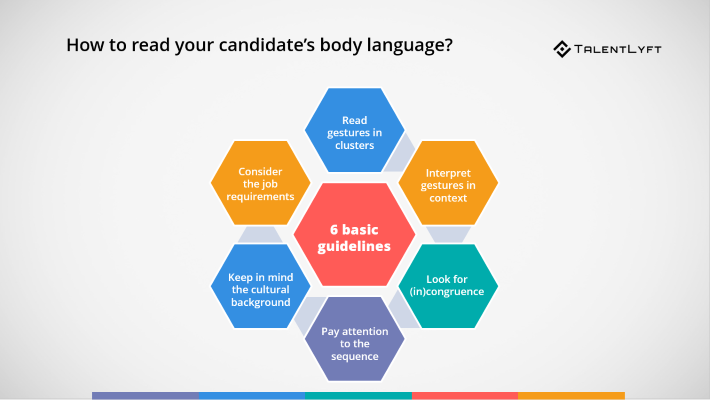
Guideline #1: Read the candidate’s gestures in clusters
The biggest mistake beginners make when trying to read a candidate’s body language is to focus solely on a certain gesture.
For example, if a candidate scratches his head, this can be interpreted as a sign of many things: lying, forgetfulness or simply dandruff.
You can’t rely on a single gesture to know which interpretation is true. For correct reading, you have to look for a cluster of gestures.
Guideline #2: Interpret the candidate’s gestures in context
The second major mistake beginners make when trying to read a candidate’s body language is to focus solely on the gestures and ignore the context of the situation.
For example, if a candidate is sitting with his arms and legs crossed, this will usually indicate a defensive attitude.
However, a candidate might simply feel cold because the air-conditioning temperature is set lower in your office than in the waiting room. ❄️
For a correct reading of body language, you should always interpret body signals in the context in which they occur.
Guideline #3: Look for (in)congruence
The best advice I can give you for reading candidates’ body language is to trust your intuition.
You know that situation when you found a candidate who seems perfect on the paper?
This candidate comes in for the interview and gives all the right answers, but… Something seems off.
You can’t put your finger on it, but your instinct is telling you this is not the right candidate.
What is probably going on here is that you unconsciously noticed the difference between what the candidate is saying verbally and what his body is showing.
The most successful recruiters know this and they rely on their “gut feeling” to choose the best candidate.
Guideline #4: Pay attention to the sequence
When observing a candidate’s body language, pay attention to the sequence of the verbal statements and body gestures.
If the answer is genuine, the body will show it first and the verbal response will follow. If the reverse happens, it can be a sign of insincerity.
For example, if an interviewer says: “This job would require traveling.”, and the candidate responds with a and then says “That would be great.”, this candidate is probably sincere.
But if a candidate responds with a verbal statement first, followed by a smile, you should question this candidate’s sincerity.
Guideline #5: Keep in the mind candidate’s cultural background
When considering a candidate’s body language, keep in mind their cultural background.
For example, it would be a mistake to write off candidates with an Eastern cultural background because they seemed a bit more reserved compared to Western candidates. It doesn’t necessarily mean that they are less excited about the job.
Generally speaking, eastern cultures tend to be more reserved, less direct with gestures, and keep a wider interpersonal distance than Western cultures.
To learn more about cultural differences in body language, check out this informative infographic.
Guideline #6: Consider the job requirements
When you observe the candidate’s body language, it is important to keep in mind the job description and the job requirements you are looking to fill.
For example, you should pay more attention to the body language of the candidates you are considering for the roles such as PR, sales, etc. because these jobs require excellent communication skills and making a great first impression.
However, if you are looking to hire candidates who will spend most of their time behind a computer in solitary work, such as developers, then outstanding programming skills may be more important than their body language.
Tips and tricks for reading candidate’s body language
Here I will provide quick tips and tricks to help you with 3 most common questions HR professionals ask me when it comes to assessing their candidates’ body language during interviews.
How to spot a liar?
Look for these 5 main indicators:
- Covering the mouth with a hand
- Touching the nose
- Maintaining strong eye contact
- Pulling their body inward
- Slight change of the tone and cadence of speech
How to recognize a fake smile?
Look for these 3 main indicators:
- Eyes are wide open
- No characteristic wrinkles around the eyes
- A smile appears stronger on one side of the face than the other
How to deal with a “professional” interviewee?
“Professional” interviewees are those candidates who come in with prepared answers and play everything out perfectly. You can that they are experienced and well prepared.
If you want to see their true colors, you need to catch them off guard. A simple way to do this is to get them out of the interviewing room.
Give them a tour around your office and introduce them to your team members. This is where you can see their unrehearsed body language, so watch out carefully!
Recruiters, beware: Your body sends signals as well!
If you really want to leverage the power of body language in recruiting, you should keep in mind that your body sends out signals to the candidate as well.
The same way you are observing your candidate’s body language, the candidate is observing your body language.
Even if the candidates are not aware of it, they can unconsciously pick many different signals from your body and facial gestures.
In order to preserve a strong Employer Brand and ensure a great candidate experience, you should help your candidates relax and open up.
You will do that by using a positive body language:
- Remove the barriers between you and the candidate (such as computer screen etc.)
- Uncross your arms and legs
- Feel free to gesticulate
- Reveal the palms of your hands
- Lean towards the candidate
- Keep an eye contact
- Smile.
Two body language techniques, called matching and mirroring are especially important for building rapport between the interviewer and the candidate.
Using these two techniques, the interview can encourage the candidate’s self-disclosure and gather important information faster and easier.
How to become an expert in reading a candidate’s body language?
Reading a candidate’s body language is not an exact science.
Besides being observant and well-versed in different body gestures, you should always interpret them in clusters and in context while keeping in mind the candidate’s cultural background and the requirements of the job.
Learning this skill takes quite a lot of effort and time, but it’s well worth it.
Being able to read your candidates’ body language will definitely give you a great advantage and improve your hiring success.
If you’re determined to master the skill of reading a candidate’s body language, you should follow 2 steps:
Step #1: Study
➡️If you want to learn more about body language, I suggest reading an insightful article from Business Insider that will teach you how to interpret the 19 most common body gestures.
➡️If you really want to master the art of reading your candidates’ body language, I highly recommend “ The Definitive Book of Body Language ” by Allan and Barbara Pease, the internationally renowned experts in human relations and body language.
Their book is very easy and fun to read, yet filled with a lot of useful information and examples. This book should definitely be on every successful recruiter’s reading list.
Step #2: Practice
Practice makes perfect!
The more you practice, the more you will start noticing subtle gestures that a non-trained eye could easily omit.
So start paying attention to your candidate’s body language today and soon you will be able to read your candidates like a book!
Applicant Tracking, Recruitment Marketing, Sourcing and Talent CRM software are powerful alone, but unstoppable when used together!


