How to Hire for Cultural Fit and Retain 86% of Employees
- Guest Author
- May 13, 2019
How does Zety retain 86% of their employees?
Hire for personality, train for ability
How to attract cultural fit candidates?
Step 1: Manage your online presence strategically
Step 2: Pen your job descriptions unique to your company
How to interview for cultural fit?
Value #1: Teamwork
Value #2: Transparency
Value #3: Accountability
Conclusion: Hire the right people by going for personality over skills
About the author
Applicant Tracking, Recruitment Marketing, Sourcing and Talent CRM software are powerful alone, but unstoppable when used together!
Retention starts with hiring! By learning how to hire for the cultural fit you can prevent your existing employees from jumping ship and build a high-retention environment from scratch.
How does Zety retain 86% of their employees?
If you want to stop making 6-figure hiring mistakes, I have a solution for you – value-driven hiring.
➡️ Download our free eBook: Transform Your Hiring Process from Reactive to Proactive !
Instead of spending hours on onboarding new hires and getting them up to speed – throwing $550 billion a year at productivity issues – you can prevent your existing employees from jumping ship and build a high-retention environment from scratch.
In fact, at Zety, we use value-driven hiring to flatline turnover, and it enables us to retain 86% of our employees.
Sold? Good. In today’s post, I will walk you through steps that guarantee hiring success.
Hire for personality, train for ability
As your business becomes larger, you want to hire extra people that would help you grow .
What you do not want is to take a leap of faith and end up with a nightmare scenario.
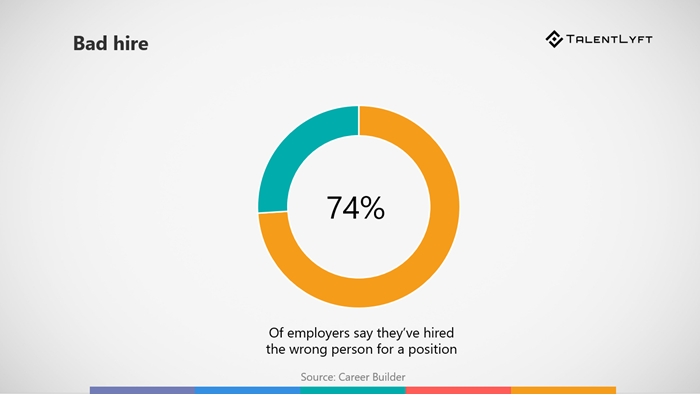
This is when you need to maximize the odds of recruiting the right people who will be superstars all the way and stay for the long haul.
Now, what defines the right people? Skill set and experience, right? Wrong .
If you hire a person with all the qualifications in the world but with a personality that does not align with your core values – it will be heartache all the way.
According to Piotrek Sosnowski, VP & Co-founder at Zety:
You can train up a person to do their job in no time, but you can't train them for amazing personality and make them align with your vision and your culture.
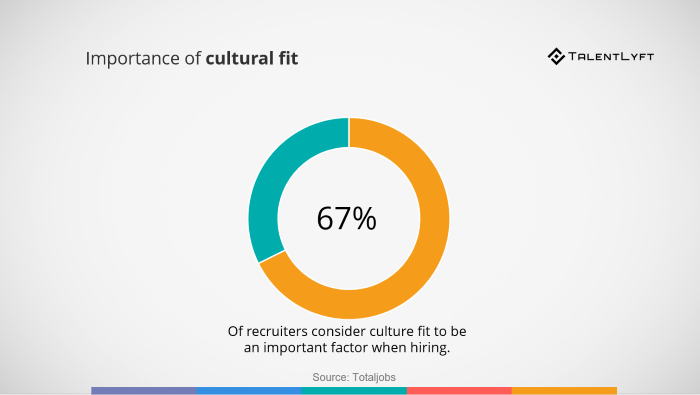
On board so far? Good. So how do you attract great people for cultural fit over skills?
How to attract cultural fit candidates?
Here are 2 main ways you can ensure that you’ll attract the right type of candidates that will fit your company culture:
Step 1: Manage your online presence strategically
Your online presence is a window into your culture, vision, and values. It is a peek at what it is like to work in your company. At least, it should be if you want to attract the right talent.
That is why it is important to learn how to promote your company culture to attract top talent. You need to tweak both your LinkedIn presence and your career site byover-communicating what your company stands for. Why?
Because it will help you screen the candidate pool and ultimately help you end up with culture-fit candidates. So here are a few tweaks you can throw on your About Us page to help you attract the right talent:
● Make sure you articulate your company vision
For example: "We want to create the best career advice website on the planet connecting employees with job seekers."
● Highlight the core values that your business stands for
For example: "We work in an environment where transparency is a value that all of our people share. And collaboration is something that we thrive on."
Putting your expectations upfront is going to brush off a lot of people. On the flip side, you are going to end up with a solid list of culture-fit candidates who will make a significant contribution to your business.
Step 2: Pen your job descriptions unique to your company
Your job postings need to reflect your company culture and connect back to your core values to vet candidates for cultural fit.
So make sure you that when you list job requirements , you include the competencies that you value the most and what people can expect from your culture. For example:
We are looking for a PHP Back-end Developer who thrives on accountability and teamwork. If you are not OK with hard culture, this place might not be a good fit for you.
Now, you don’t want to sugarcoat things and say something that you do not stand for. In the end, people will get disappointed when reality hits and their expectations are not met. And that will manifest in attrition.
So always be upfront about your expectations, and you will have people who will run with your business without jumping ship.
How to interview for cultural fit?
So far so good. You have managed to attract potentially great candidates for your business.
And now, it is time to vet for cultural fit by asking open-ended cultural fit interview questions designed to unveil whether or not the person’s work priorities align with your business culture.
Let’s say your organization’s top 3 values are teamwork, transparency, and accountability:
Value #1: Teamwork
Now, most interviewers tend to ask teamwork questions that do not work. For example:
Do you prefer to work on your own or collaborate with other individuals?
Questions like this one give the candidate a tip-off to the right answer, which is going fake their response.
So instead, you can ask a few proven interview questions to uncover a real team player :
Can you tell me about a time you were working on a team?
This one is not very sexy, but it is designed to be an open-ended question, which does not give you the right or the wrong answer.
OK, now it is time to pause.
Because right before you go ahead and interpret the candidate’s answer, you need to be 100% clear that the candidate is a good fit based on your own definition of teamwork.
Let me explain using an example.
Business A:
" We have 8-people teams that thrive on friendly competition. We all have a shared goal in mind, but the individual contribution is an essential driver of our employees."
Business B:
"We are a tightly-knit community of people that always work together and who are always willing to offer a helping hand. Every morning, we give hugs to each other and go out to do fundraising."
Different organizations have a different concept of teamwork. So depending on your own definition of teamwork, you need to interpret the answer differently.
And now, back to the question:
Can you tell me about a time you were working on a team?
Answer #1:
"Along with the other team leaders, I was tasked with a project that required me to streamline the existing product.
This way we would have been able to lower the costs and offer it to a broader range of customers. I came up with the necessary adjustment and presented those to our CEO and other team leaders.
Later on, I discovered that one of my peers met privately with the CEO and ripped my idea apart. Well, I was OK with that.
I doubled down, I hustled, and in the end, my ideas were implemented but not those of my peers."
Answer #2:
"In my last job, I was working on a team that was responsible for creating a podcast. We got together and worked in concert as if we were an orchestra.
We all had our own roles to play, but we were committed to creating this great whole."
Now, if you are looking for people with what’s in it for me attitude, you know you have struck gold when they give you Answer #1.
But if you are into the warm and fuzzy team experience, Answer #2 is your choice.
Value #2: Transparency
Any person who has some work experience and especially managers have had some missteps along their career. It is inevitable.
Now, if you want to probe the person for how transparent they are willing to be, you can ask them:
What was the biggest failure in your career?
Good answer:
"When I was just starting, I interned in a marketing agency. Halfway along with my internship, I was asked to set up a simple WordPress site within 1 day for some sort of marketing experimentation purpose to which I agreed.
The problem was that I didn't tell anyone that I knew nothing about WordPress, so I naturally failed.
What I took away from that situation is that you should always communicate and over-communicate the issues that you run into so that it is possible to turn things around and save the situation.
This is what I always did in my last job, and my team leader really liked this quality in me."
Bad answer:
"Well… my career has been silky smooth so far, and I can't think of any misstep on my part. All the failures in my previous organization were on my peers."
So the problem starts when the candidate has trouble talking about missteps in their career because it shows that they are not willing to integral.
On the other hand, if the potential hire can admit to making a professional mistake in the past, and learning from it (giving you hard evidence), this surely is a good sign of transparency.
Value #3: Accountability
If you want to examine the candidate’s accountability skills and whether or not they are willing to walk the extra mile to get the job done, here is a good question you can ask:
Tell me about a time you went above and beyond.
Good answer:
"There was this time when our sales team needed some extra hands, as some of the salespeople got sick.
So instead of going home, I stayed up late and put my best foot forward.
In the end, we closed some really sweet deal with one of our SMB clients."
Bad answer:
"Err… once I solved Rubik's cube when my team lead could not do it…"
So what is the takeaway?
If the person can paint a picture describing a time when they overachieved or did more than was expected of them – great. You are on the right track.
But if what you get is some kind of fluffy answer like the one about Rubik's cube – that is a red flag.
Conclusion: Hire the right people by going for personality over skills
Inevitably, some of your employees might at some point quit. What you can do is hire the right people by going for personality over skill.
However, make sure that you’re familiar with the disadvantages of hiring for cultural fit alone !
Ultimately, you will create a healthy ecosystem where everyone is working toward the same goals and enjoy much better employee longevity.
About the author
Max Woolf is a writer. He’s passionate about helping people land their dream jobs through the expert career industry coverage.
In his spare time, Max enjoys biking and traveling to European countries. You can hit him up on LinkedIn or Twitter.
Applicant Tracking, Recruitment Marketing, Sourcing and Talent CRM software are powerful alone, but unstoppable when used together!


