It’s Time to Make Employee Training Digital
- Guest Author
- August 21, 2018
What is employee training?
Why do you need to make your employee training digital?
Employees want digital training
Digital training for the digital age
Benefits of making employee training digital
Benefit #1: It’s cost-effective
Benefit #2: It increases interactivity
Benefit #3: It’s time effective
Benefit #4: It’s highly flexible
5 ways to enable digital employee training programs
E-learning trend #1: AR/VR
E-learning trend #2: Microlearning
E-learning trend #3: Adaptive learning
E-learning trend #4: Social learning
E-learning trend #5: Gamification
Conclusion: It’s time to make your employee training digital!
About the Author
Applicant Tracking, Recruitment Marketing, Sourcing and Talent CRM software are powerful alone, but unstoppable when used together!
It’s time to make employee training digital! While traditional forms of training like classroom-based seminars and lectures were effective earlier, that’s not the case anymore. With the expansion in the learning paradigm and a huge increase in the number of millennials taking over the workforce, the need to make employee training digital is now more than ever.
What is employee training?
Training refers to educational program s taken by employees to enhance their knowledge and skills. Employees then use these skills to improve their performance in their current job and prepare for future tasks or jobs.
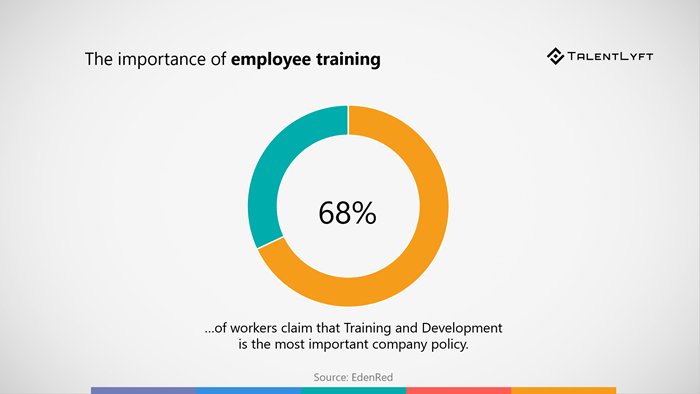
A recent study shows that 68% of workers claim that Training and Development is the most important company policy.
Helping employees advance their professional development can lead to higher employee engagement and retention. This is a very effective way to nurture and engage your employees to stop them from leaving. After all, employee engagement is the key to better business results!
Why do you need to make your employee training digital?
So, training is definitely important. But why the need to shift to a digital-like employee training? Why is it the time to make employee training digital?
There are 3 main reasons why you need to make your employee training digital.
- Employees want digital training
- We live in a digital world
- Problem solving, creative thinking, digital skills, and collaboration are in greater need every year but are not explicitly taught in schools.
Employees want digital training
First, some factual reasoning:
- 40% of workers said they left a company because they lacked access to state-of-the-art digital tools.
- 58% said they needed to work elsewhere to gain digital skills.
Digital training for the digital age
Also, because the age is digital.
Social media and other technology has completely taken over our lives. Before buying a product or going to a new restaurant, we like to know about it beforehand. We like information that is within our reach and accessible.
The same is with employees. Before doing a task, they want to be informed and trained for that responsibility. They want information that is readily available and can be used and reused. Also, none of us have the time or the wish to sit for a three-hour training session.
Hence, the need for e-learning tools and practices become important.
Benefits of making employee training digital
There are many benefits to making employee training digital.
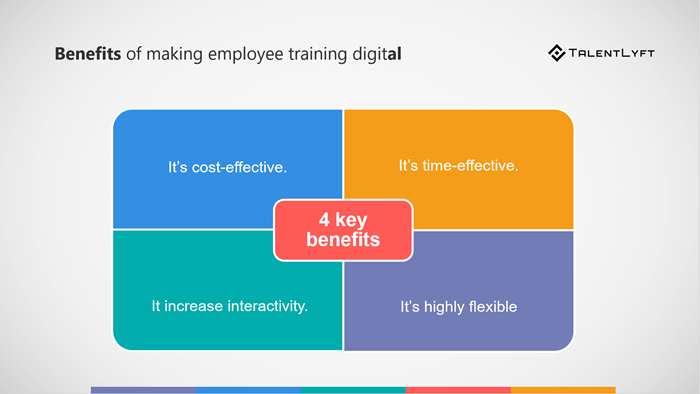
Here are the 4 key benefits of making employee training digital:
Benefit #1: It’s cost-effective
Digital training is cost-effective. Employees don’t have to travel to undergo training or invest in special equipment and hefty study materials.
Benefit #2: It increases interactivity
E-learning helps increase interactivity in on-site training. Trainers who already have the skill and knowledge can easily equip themselves with the possibilities of digital technology. This also causes a real change management in the training departments.
Benefit #3: It’s time effective
It is time-effective and it accelerates work. All work done in an organization can be done “faster” when done digitally. Creating, upgrading, searching can all be done faster. This helps learners and increases the overall productivity and revenue of an organization.
Benefit #4: It’s highly flexible
E-learning is highly flexible. It allows employees to log in to their system and complete their training whenever they can. If an employee is called in between his training session, they can also pause and resume at a later stage.
5 ways to enable digital employee training programs
It’s 2018. You have finally decided to shift from a manual to a digital training program. Might as well install the latest workplace trends and practices right?
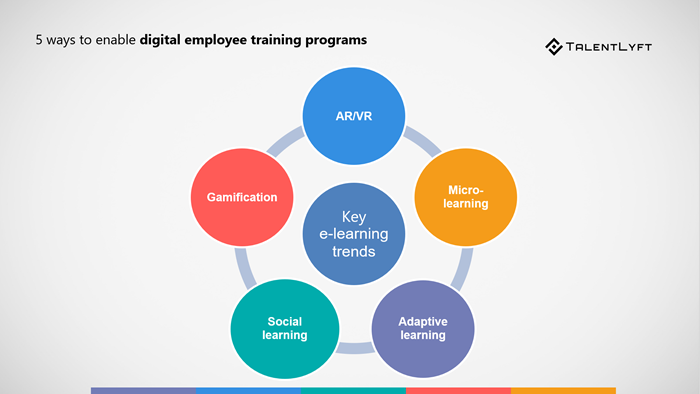
To make things easy, I have listed below the latest e-learning trends:
E-learning trend #1: AR/VR
Augmented Reality and Virtual Reality are the buzzes of the town nowadays. Corporates have already started to incorporate AR and VR in their training programs. Studies have also found that employees using an AR or VR platform perform a lot better than those using other methods.
Instead of watching videos and reading long texts, these highly developed platforms allow the users to place themselves in role-playing situations. Such features allow users to get an in-depth understanding of the situation, the areas of concern without actually facing any risk.
Benefits:
Embraces safety, focuses on a practical approach than a theoretical one, users can learn from their mistakes without actually causing any financial or other harm to the company.
E-learning trend #2: Microlearning
Microlearning is designed for employees who have very busy schedules and can’t devote their time to training every day. It is also for the new age employees who are infamous for their short attention spans.
It refers to small, short-term learning activities conveyed through videos, podcasts, etc. The content is designed in a way that divides long content into small, digestible bites. Each module spans for a maximum of 10 minutes and tries to address only one learning objective at a time.
Benefits:
These modules are mobile-friendly, delivers information anytime and anywhere, increases information retention, engages millennials and increases the ROI.
E-learning trend #3: Adaptive learning
All people are different. They are different in their capabilities, their preferences and have different goals and expectations. So, why should they be subjected to the same training programs and modules? The solution – Adaptive Learning.
Adaptive learning is an educational method using computer algorithms to manage interactions with the learner. It focuses on adapting an employee’s learning structure to their personal goals, preferences, and areas of weakness and deliver customized resources and learning activities.
Benefits:
Customising content for each employee engages them and helps retain the information easily. It is flexible, interactive, saves time, increases efficiency, etc.
E-learning trend #4: Social learning
In the simplest sense, social learning means learning continuously from other people. Research shows that 73% of organizations expect to increase their focus on social learning in the next few years. So, how can you make this process digital and why is it important?
Social learning can be made digital by making employees learn from their colleagues through blogs, discussion forums, live chats, videos, podcasts, etc. Integrating other social media features like “like and comment,” share, are some very good practices.
Benefits:
People are already familiar with using social media. Using a similar process makes learning easy. It also helps lighten the learning process. Learning together also reduces feelings of isolation, increases the exchange of knowledge, perspective and skills.
E-learning trend #5: Gamification
Games have been an age-old convention to pass time with friends and family. But now corporates are seriously considering gamifying their training processes and programs.
A dictionary defines gamification as:
the application of typical elements of game playing- point scoring, competition with others, rules of play -to other areas of activity… to encourage engagement with a product or service.
Gamification features are easily available on LMSs today. So, you should seriously consider incorporating this into your system if you have some great games in mind.
Benefits:
Makes e-learning fun, engaging and interactive, increases knowledge absorption and retention. Makes employees competitive which enables them to perform better. It also enhances the learning experience of people from various age groups.
Conclusion: It’s time to make your employee training digital!
The time we live in is digital. Therefore, to create an office of motivated, engaged and highly skilled employees, carefully consider and choose the means of e-learning best fit for your organization.
Making your employee training digital is a great way to make your organization talent worthy . It will also help you keep your best employees .
About the Author
Shreya Dutta is a content writer and marketer at Vantage Circle. When she’s not writing, she’s either trying her hand at calligraphy or watching world movies and anime.
Applicant Tracking, Recruitment Marketing, Sourcing and Talent CRM software are powerful alone, but unstoppable when used together!


