Resignation Notice Period Lengths in Europe and Why it Matters in International Recruitment
- Guest Author
- December 12, 2023
Applicant Tracking, Recruitment Marketing, Sourcing and Talent CRM software are powerful alone, but unstoppable when used together!
Notice period lengths vary significantly across Europe, ranging from a few weeks to several months, depending on the country and the specific employment contract. Being familiar with resignation notice period lengths in European countries is crucial for employers seeking to hire professionals from outside their own country.
Knowing the notice period length also helps recruiters – they can set realistic expectations for the recruitment process and communicate clearly with both the employer and the candidate about the expected timeline for onboarding and the transition period.
This article will explore the importance of resignation notice period lengths in international recruitment and provide insights into the varying notice periods in different European countries. To make it easier for managers and recruiters to grasp the notice period spectrum across Europe, we’ve conducted a study and compiled its findings in one thematic map and a chart outlining conditions that influence notice period length.
What is a notice period?
A notice period is the time an employee or employer must provide advance notice before terminating an employment contract or resigning from a job. It is a standard practice in many industries and countries and serves several important purposes:
- Transition time: The notice period allows both the employer and the employee time to prepare for the end of the employment relationship. This includes finding a replacement or a new job, completing pending tasks, and ensuring a smooth transition of responsibilities.
- Legal requirement: Notice periods are often legally required, outlined in employment contracts or labor laws. Failing to comply with these requirements can lead to legal consequences or financial penalties.
- Fairness: Notice periods provide fairness and predictability to both parties. Employees have time to seek new employment, and employers can plan for the departure of a valuable team member.
In this post, we’ll focus on resignation notice periods – the time an employee continues working between delivering their resignation letter and their final day of work. Knowing the notice period length of a potential new hire is crucial to be able to plan the timeline of the recruitment process and other business processes.
The importance of notice period length in international recruitment
What role does notice period length play in situations when employers want to expand their business internationally? There are situations when this seemingly small detail can even influence the choice of a country.
How come? Let us explain.
Imagine you’ve just opened a new branch in a country and started hiring your first local employees. Then you realize that the standard notice period length in this country is not one month like in your country, but three months. This means you won’t be able to hire highly skilled workers anytime soon unless they’re currently unemployed. If you realize this too late, the consequences can slow your operations and eventually harm your business.
Conversely, countries with shorter notice periods allow you to grow your team faster. Luckily, many countries indeed require a one-month notice period or even less (as our thematic map and chart will demonstrate).
Here are some other ways in which notice period length can influence international recruitment:
- Recruitment process length: Knowing the notice period of potential candidates helps to plan the recruitment and onboarding process. In the case of urgent hiring needs, recruiters or managers can identify individuals who can start sooner, reducing the time to hire.
- Compliance with legal requirements: Employers must be aware of the legal notice period requirements in the countries they are recruiting from or to, as failing to comply with these requirements can lead to legal consequences and potential disputes.
- Flexibility in employment contracts: Understanding the notice period lengths in different countries allows employers to negotiate more flexible employment contracts, which can be particularly important for international recruits.
- Cost of hiring: If a candidate has a long notice period, the recruiter and the employer must consider the potential delay in productivity and the compensation required to attract the candidate away from their current job.
- Cultural considerations: Being aware of the cultural norms surrounding notice periods can help employers better understand the expectations and preferences of potential employees, making the recruitment process more efficient and successful.
- Employee retention: Once you’ve hired your team, longer notice periods can benefit your business, as they provide you with more time to find suitable replacements for departing employees.
Notice period lengths in European countries
Recognizing the importance of notice periods in recruitment, our team studied European countries, compiling typical notice period lengths in one thematic map. We focused on employee resignation notice periods, as in some countries, the time of notice given by the employer can differ from that given by the employee.
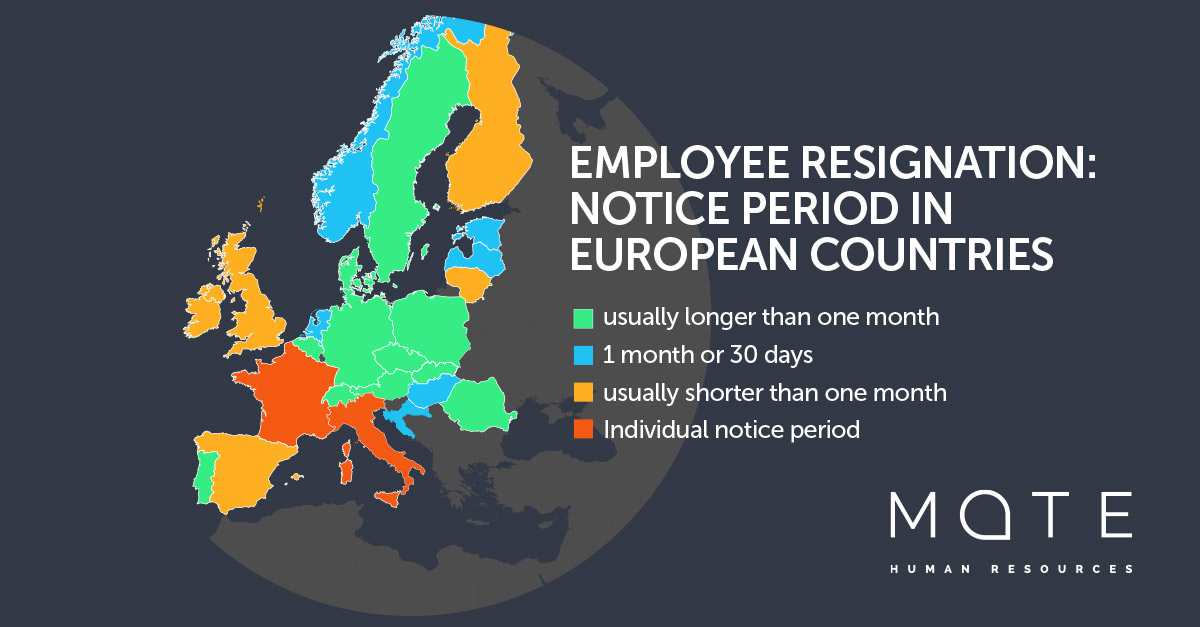
This map displays the majority of European countries, divided into four categories based on their notice period lengths:
- standard (one month) notice periods
- typically shorter than one month
- typically longer than one month
- individual notice period – applies to Italy and France, where notice period lengths can vary greatly, depending on many factors.
It’s important to note that this map can only provide an overview of notice period lengths in European countries, as conditions outlined in employment contracts can influence this period significantly. That said, it’s helpful to know the customary notice period lengths if you’re looking to hire several people or whole teams, as it can give you a general idea of countries where you could recruit people faster.
What conditions influence notice period length?
Various factors, such as legal requirements, cultural norms, contract terms, and the specific industry or job position, can influence notice period length. Some countries have standardized notice periods, while others allow for more flexible arrangements depending on the context.
Typically, the longer the employee has been with the company and the higher their expertise, the longer their resignation notice period will be. In addition, some highly skilled employees have signed NDA agreements or legal consent that forbid them to work for competing companies for a set amount of time.
For example, in the United Kingdom, employees are expected to serve at least one week's notice if they have been employed for one to two years, with the notice period increasing by one week for every additional year of service, up to a maximum of 12 weeks.
In contrast, Germany has a more complex system, with statutory notice periods ranging from four weeks to seven months, depending on the length of service.
To make things even more complex, countries with strong trade unions, like France or Italy, don’t mention standard notice period lengths at all, as those can only be stipulated in the collective bargaining agreement (CBA) or employment contract.
With this chart, we’ve looked deeper into the customary notice period lengths in 24 European countries, ranging from a few weeks to several months. The colors mark the categories of notice periods by country (individual, one month, longer, and shorter than one month).
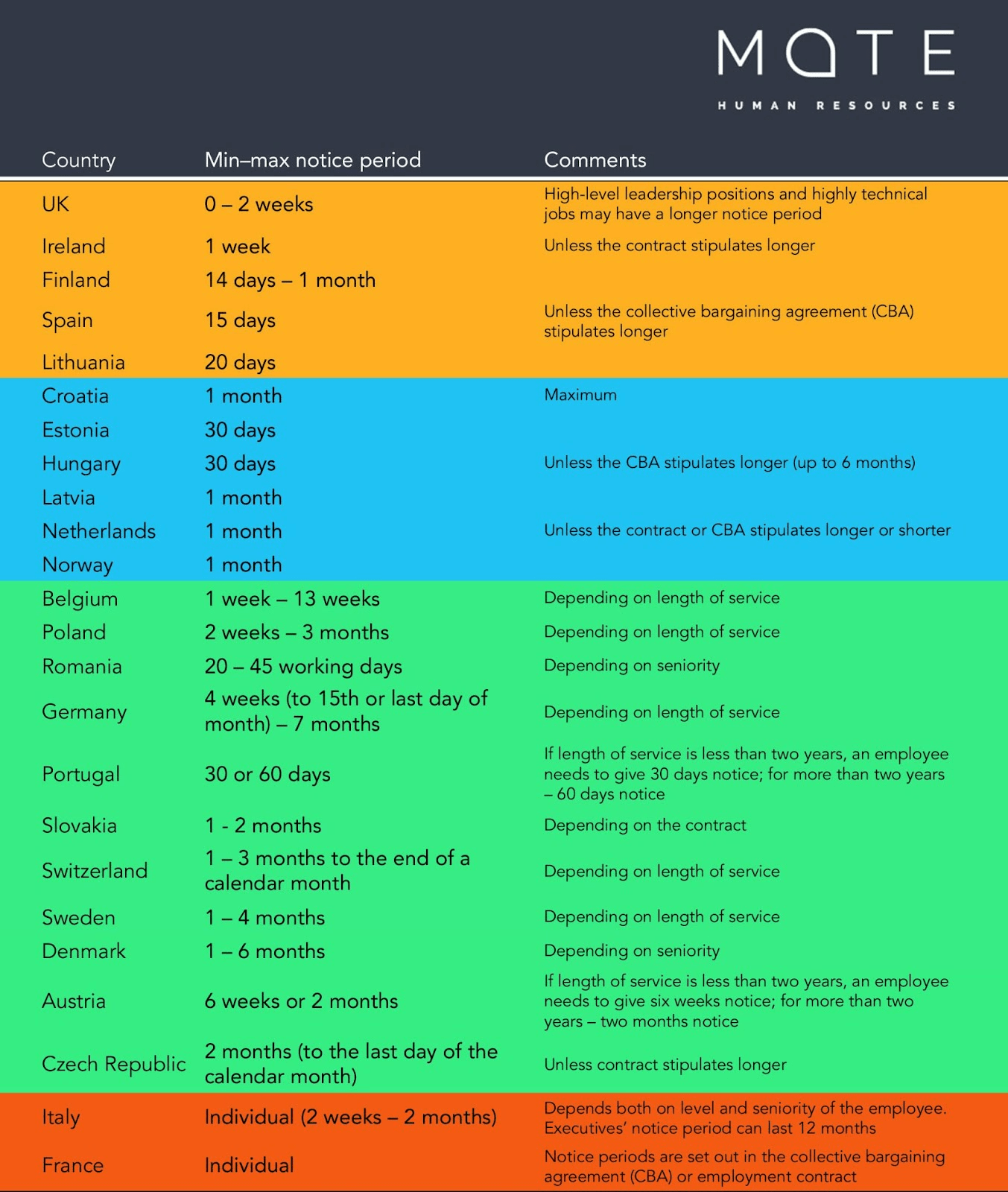
The third column of the chart provides comments about the conditions that can influence or change the length of the standard notice period. You can see that there is often a notice period interval, depending on the employee’s length of service or seniority.
The chart doesn’t include information about notice periods that apply during employee probation as they are typically much shorter, starting with no notice period up to one or two weeks.
The unexpected deal-breaker in international recruitment
Understanding notice period lengths in European countries is essential for employers involved in international recruitment. By being aware of the legal requirements, cultural norms, and industry-specific practices, employers can better navigate the recruitment process and ensure compliance with local laws and regulations.
Additionally, awareness of the resignation notice period length when recruiting employees is vital for effective planning, communication, and expectation management. Understanding the flexibility and potential for negotiation in employment contracts can help employers attract and retain top talent from around the world.
About the author
Maris Tepers is the founder and CEO of the IT recruitment agency MateHR. He has a 12-year background in HR and recruitment and five years of experience as a business owner. To help managers and recruiters hire international talent, Maris’ team studied notice period lengths in European countries, compiling them in one thematic map along with a chart outlining notice period conditions.
Applicant Tracking, Recruitment Marketing, Sourcing and Talent CRM software are powerful alone, but unstoppable when used together!


