Employee Satisfaction Surveys: How It Is Increasing Employee Engagement In 2021
- Guest Author
- June 14, 2021
The Basics of Employee Engagement
High level of engagement
Moderate level of engagement
Low level of engagement
The level of total disengagement
The Benefits of Employee Engagement
The Importance of Employee Satisfaction Survey
Employee Satisfaction Survey Questions to Ask
1. Workplace culture set of questions
2. Work management set of questions
3. Job-related set of questions
Conclusion
Author Bio:
Applicant Tracking, Recruitment Marketing, Sourcing and Talent CRM software are powerful alone, but unstoppable when used together!
Think back to 2019 for a second and recall the situation with the level of employee engagement. There’s a good chance that it was pretty high! Employees had a strong desire to work, and businesses had lots of opportunities to hire niche-related professionals. 2020 brought with itself a pandemic, and everything changed. Did it have an impact on employee engagement? Yes, definitely. This impact is a mixed bag – you can never know whether the level of employee engagement decreased or increased without running an employee satisfaction survey. How to do this and what are the results can you expect? In this guide, you will find out everything you should know about the employee engagement survey.
So, shall we begin?
The Basics of Employee Engagement
First of all, you should have a clear understanding of the meaning of “engagement” in terms of employment. Engagement is not about how employees like to work in a company. It is more about how they act in the company.
In a nutshell, employee engagement stands for what emotional commitment the employees have towards their work. It is tightly connected with a team, professional duties, and the overall company’s mission.
Employee engagement can be divided into a few levels. Let’s review them one by one:
High level of engagement
Employees love their job. They are loyal to the company, its culture, and try to perform their work the best.
Moderate level of engagement
Employees like their job but they are less engaged in the process. These people work just to get paid. Nothing more.
Low level of engagement
Employees don’t want to dedicate themselves to work with interest. This group of employees lacks motivation. Moreover, they will never miss a chance to leave the company.
The level of total disengagement
Employees have a negative attitude towards the workplace. They criticize everything and don’t believe in a company’s success. As a rule, these people demoralize the working atmosphere. You noticed that employee engagement involves an emotional side of the question. It is for a good reason because engagement is based on the emotional connection between employees and their workplace.
Ask yourself – what could be an ideal way to trigger the positive emotions of employees?
Your first thought might be to pay bonuses, increase a salary, allowing a flexible working schedule. You are right, but these methods are outdated. Plus, they don’t have a direct impact on the level of employee engagement.
Other companies do the same to satisfy the needs of their employees. Thus, there is nothing strange if your employee will want to leave your company. Because this employee knows that these options of “happiness” are available at every solid company.
So, what are the factors that affect employee engagement?
The factors that have a positive influence on the level of employee engagement are inspiration, motivation, confidence, and a sense of agency.
If your employees understand that they are a part of the big family, they won’t leave the company.
It is to be noted that managers play a vital role in building an “employees + company” engagement.
There are three main functions that managers fulfill:
-
Prioritization of employee development
Managers have a direct connection with the employees. Therefore, managers lay the foundation for the future level of engagement.
Now, let’s find out why employee engagement is important.
The Benefits of Employee Engagement
Employee engagement has a bunch of benefits for your company’s productivity. Let’s review them:
If the employees enjoy the work, they will want to complete their tasks in time.
If the employees feel that the board of directors appreciates their work, they won’t have a desire to change the company. Employee retention is often underestimated, yet can bring real benefits to the company.
-
The improved customer experience
Customer experience depends on the happiness of the employees of the company. If the managers treat their employees well, the last ones will be welcoming towards your customers. Remember that professional customer service is a cornerstone of your company’s success.
-
The rise of the profits
Employee productivity leads to a high level of job performance. It means your company will have more chances to earn money.
You already know the basics and the benefits of employee engagement. But what you don’t know is how to run an employee satisfaction survey that will help you improve the level of employee engagement.
Keep on reading and you’ll find out!
The Importance of Employee Satisfaction Survey
A level of job satisfaction has a direct impact on the company in general.
How does job satisfaction affect the overall company performance and success?
There is a cause-and-effect link that involves the following consequences:
-
Unsatisfied employees don’t like their job that leads to a low productivity
-
Unhappy workers hurt employee morale
-
Employees with job dissatisfaction reflect their negative mood on customers
-
Having more unsatisfied employees means fewer chances to attract new talents
To avoid these issues with employee engagement, you’ll need to run employee satisfaction surveys regularly. It would be better to create a survey anonymously.
People hang out on social channels most of the time. Thus, you can run a survey across socials. To make this happen, you can hire a social media manager who would handle this task.
You might wonder what questions should be included in the survey. Let’s find out!
Employee Satisfaction Survey Questions to Ask
To make sure you can get honest answers to your survey questions – avoid business jargon and be more friendly. Try to show your employees that you care about them. You want to help them feel safe and comfortable working at your company.
What are the questions you should include in the survey?
You should split questions into three groups – workplace culture, work management, and job questions.
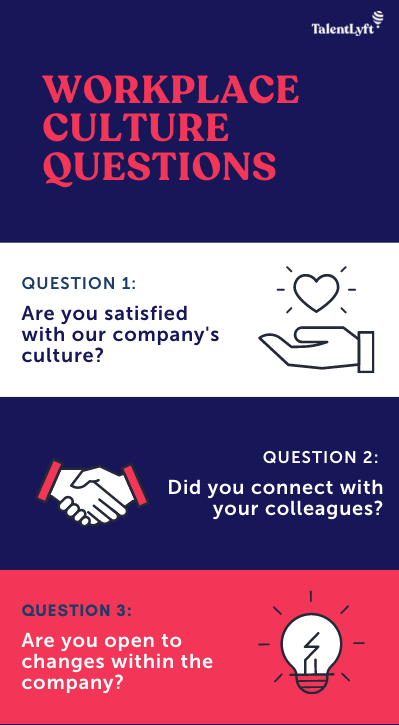
1. Workplace culture set of questions
Every solid company has its corporate culture. This survey states that 74% of 1000 respondents believe that culture plays a vital role. Corporate culture is a significant part of the life of any company.
What are the right questions to ask about a company culture?
-
Are you satisfied with our company’s culture?
You should know that among the top factors related to employee satisfaction are interpersonal relationships, work environment, and culture. Hence, if your employees are not happy with your company’s culture, you will need to change something.
-
Do you have a connection with your colleagues?
If your employees don’t build a friendship within the team, they won’t be happy to work at your company.
-
Are you open to new changes in our company?
Stagnation is a way to nowhere. Any CEO must suggest new changes that would help take the company to the next level. Also, you should ask the opinion of the employees. If workers know that their feedback is taken into account, they will feel themselves a part of the mechanism.
2. Work management set of questions
Managers build a bridge between employees and the board of directors. One of the managers’ responsibilities is to make sure that workers are happy with their job and can rely on their supervisors.
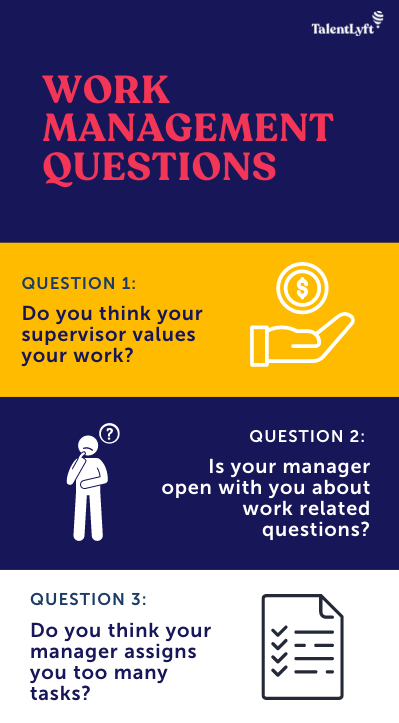
Here are a few questions to include in your survey regarding work management:
-
Do you think your supervisor evaluates your work?
Sometimes supervisors don’t care about the personal achievements of the employees. That hurts the overall reputation of the company and forces workers to leave their job position.
-
Is your manager open with you in the questions related to your job?
If your employees think that the managers are not honest with them in terms of the work, it might lead to misunderstanding within the team.
-
Do you think that the manager overtakes you?
70% of employees believe that they don’t have much time to complete all their tasks during five working days in a week. This means that the managers don’t smooth out the workload.
3. Job-related set of questions
There are various reasons that nudge employees to leave the company. One of the reasons is the absence of personal professional growth.
Your task is to find out other hidden pitfalls your employees might have working at the company.
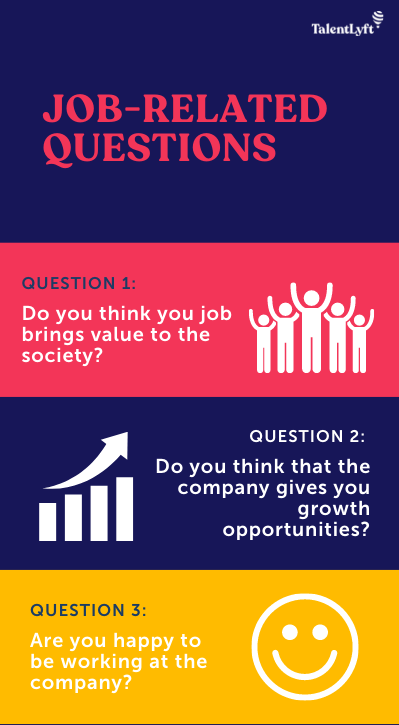
Include the following set of question in your survey:
-
Do you believe your job brings value to society?
If your employees think that their job doesn’t bring any value to society, they won’t take it seriously.
-
Do you think our company provides you with the opportunity to push your career further?
The majority of employees build their career climbing the corporate ladder. They know that the higher job position they have, the higher salary they’ll get.
Therefore, your goal is to support your employees for their career development.
-
Are you happy to work in our company?
A simple and straightforward question that requires employees to give a direct answer. If you get a negative reply, you can dive into the issue deeper until it turns into a real problem.
It is up to you what questions to include in your survey. The goal is the same – to find out why your employees are not satisfied working at your company.
Conclusion
Keeping employees happy at work is a challenge. You can’t predict how each employee is going to react to the company culture.
Here’s the thing: people are different. You can’t satisfy all of them individually.
But what you can do is try to create a work environment that everyone would like. You need to focus on improving workplace efficiency.
Just listen to your employees via running employee satisfaction surveys! Trust us, they’re quite valuable!
If you think this post lacks some tips, feel free to share them in the comments.
Author Bio:
Mariya is an SEO consultant and she loves to write attention-grabbing content, when not writing you can find her playing her guitar
Applicant Tracking, Recruitment Marketing, Sourcing and Talent CRM software are powerful alone, but unstoppable when used together!


