HR Glossary

Labor force participation rate

Labor force participation rate is a measure of the proportion of a country’s working-age population that engages actively in the labour market, either by working or looking for work
what-is-labor-force-participation-rate

Labor force participation rate definition

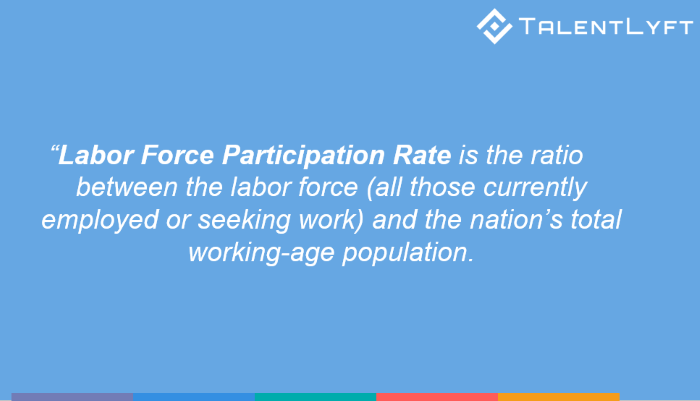
The ratio between the labor force (all those currently employed or seeking work) and the nation’s total working-age population. It provides an indication of the size of the supply of labor available to engage in the production of goods and services, relative to the population at working age.

The way we recruit people has changed dramatically, and the labor force participation rate is one of the reasons for that.

How to calculate the labor force participation rate?

The labor force is the sum of the number of persons employed and the number of persons unemployed.

Thus, the measurement of the labor force participation rate requires the measurement of both employment and unemployment.

Two types of labor force

1. Employed

Comprises all persons of working age who during a specified brief period, such as one week or one day, were in the following categories:

  • paid employment (whether at work or with a job but not at work); or
  • self-employment (whether at work or with an enterprise but not at work).

2. Unemployed

Comprise all persons of working age who were:

  • without work during the reference period, i.e. were not in paid employment or self-employment;
  • currently available for work, i.e. were available for paid employment or self-employment during the reference period; and
  • seeking work, i.e. had taken specific steps in a specified recent period to seek paid employment or self-employment.
labor force participation rate

Why is labor force participation rate important?

Tracking what is happening in the labor market is important. The labor force participation rate is related by definition to other indicators of the labor market. The labor force participation rate indicator plays a central role in the study of the factors that determine the size and composition of a country’s human resources and in making projections of the future supply of labor.

As we all know, the situation is not very favorable. There is a lack of talent, and recruiters must know how to find the right job candidates.

See TalentLyft in action

Applicant Tracking, Recruitment Marketing, Sourcing and Talent CRM software are powerful alone, but unstoppable when used together!


Related content

  • Accessibility refers to the ease with which company's facilities, products, services, functions or people are available to as many employees as possible.Definition of accessibilityAccessibility refers to...

  • Co-employment is the relationship between an employer and a firm specialized in employee leasing or a Professional employer organization (PEO).Co-employment definitionCo-employment is the relationship between an...

  • A cover letter is a written document submitted with a resume to provide additional information on skills and experience and to explain the applicant's credentials and...

  • Due diligence refers to the process of investigating and assessing a person, business or details of an investment to assess suitability, risk, potential value and reward...

Explore more topics

  • Recruitment by Industry

    Tailor your recruitment strategies to fit specific industries. Learn the unique challenges and best practices for hiring in sectors like healthcare, tech, retail, finance, and more. Discover industry-specific approaches to sourcing talent, crafting job descriptions, and optimizing your recruitment efforts for success.

  • Training and Development

    Training and development of your existing and new employees is what drives organizational success in the long term. By giving your people opportunities to educate themselves and improve their skills and expertise, you create a culture of learning, reducing turnover and improving productivity. Learn all the best practices and set up your employees for success!

  • Recruitment Marketing Strategy

    Develop an impactful recruitment marketing strategy to attract top talent. Learn how to create targeted campaigns, build a strong employer brand, and use digital channels to reach and engage potential candidates. Optimize your recruitment efforts with strategies that showcase your company culture and position you as an employer of choice.

  • Video in Recruitment

    Discover how incorporating video can enhance your recruitment strategy. From video job postings to candidate video submissions and virtual interviews, video adds a personal touch, increases engagement, and streamlines the hiring process. Learn how to use video to attract, assess, and connect with top talent more effectively.

  • HR Tech Trends

    HR Tech Trends – Stay ahead of the curve with the latest HR technology trends. Discover how innovations like AI, automation, and data analytics are transforming talent acquisition, employee management, and workplace productivity. Embrace these cutting-edge tools to optimize your HR processes and drive organizational success.

  • Remote Work

    In the evolving landscape of work, remote work has emerged as a transformative force that empowers both organizations and employees. It is a dynamic shift in how we approach work and the workplace. In this Remote Work resource section, we explore the strategies, best practices, and technologies that HR professionals, managers, and employees can utilize to excel in a remote work environment.

Simple and affordable recruitment software