HR Glossary

Time to hire

Time to hire is one of the key recruiting and hiring metrics. Time to hire metric measures how quickly a company can select and hire the best candidate.

undefined

What is time-to-hire?

Time to hire is one of the key recruiting and hiring metrics.

➡️ Download the Checklist of Most Important Hiring Metrics & Tips for Improvement!

Time to hire metric measures how quickly a company can select and hire the best candidate.

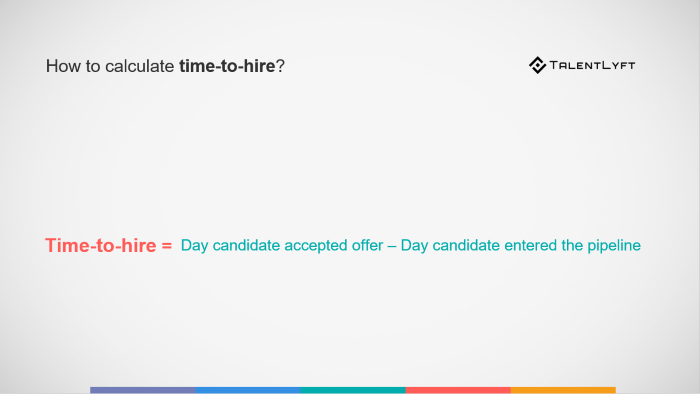
Time to hire is the number of days passed since a candidate entered your pipeline until the day you hire a new employee.

Difference between time to hire and time to fill

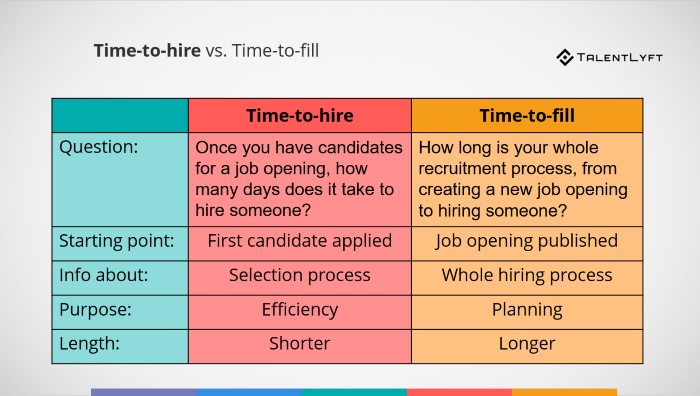
Time to hire and time to fill are often used as synonyms, but this is wrong! Time to hire and time to fill are two different metrics which measure different things.

Time to fill answers the question: How long is your whole recruitment process, from creating a new job opening to hiring someone?

Time to hire answers the question: After you have candidates (sourced or applied) for a job opening, how many days does it take to hire someone?

Time to fill is the time of your wholehiring process, while time to hire is the duration of your selection process.

Thus, time to hire is always shorter than time to fill.
undefined

A formula for calculating the time to hire

Here is the formula to calculate your time-to-hire:
undefined

Average time to hire

A recent survey conducted by Spark Hire for their 2018 Growth Hiring Trends Report surveyed 500 talent acquisition professionals in the United States.

They found that:

  • 49% of companies reported that it takes them 7 to 14 days from receipt of an application to offer letter was the norm,
  • 24% of companies reported that it takes them 15 to 30 days to make a hire.

Learn more about time to hire

If you want to learn more about time to hire, check out our detailed guide: Recruitment Metrics: Time-to-hire.

See TalentLyft in action

Applicant Tracking, Recruitment Marketing, Sourcing and Talent CRM software are powerful alone, but unstoppable when used together!


Related content

  • Abandon rate is one of the most important HR metrics. They show HR professionals how optimized and user-friendly their job application forms and process are.  Abandon rate...

  • Benchmarking is a type of measurement technique to evaluate the quality of organizations's policies, products and strategies using specific standards to make comparisons between different organizations...

  • Buzz marketing is a viral marketing technique which tries to make close, spontaneous interaction with consumers instead of an obvious marketing pitch.Buzz marketing definition Buzz marketing...

  • Change management is a collective term which refers to an overarching, guided process for transitioning individuals, teams or organizations from one state to another.Change management definitionChange...

  • Crowdsourcing means obtaining services, work, information or opinions from a large independent group of people, most often from an online community, rather than from traditional type...

  • Diversity refers to the collective mixture of similarities and differences among company's employees such as: age, individual and organizational characteristics, values, beliefs, experiences, cultural background, religion,...

Explore more topics

  • Video in Recruitment

    Discover how incorporating video can enhance your recruitment strategy. From video job postings to candidate video submissions and virtual interviews, video adds a personal touch, increases engagement, and streamlines the hiring process. Learn how to use video to attract, assess, and connect with top talent more effectively.

  • People Analytics

    People Analytics – Unlock the power of data to make informed HR decisions. Learn how people analytics can help you track employee performance, improve retention, and enhance recruitment strategies. Use data-driven insights to optimize your workforce management and build a stronger, more efficient organization.

  • Collaborative Hiring

    In the modern workplace, hiring has become a team effort, and collaborative hiring is the key to unlocking its full potential. Our Collaborative Hiring section is your central resource for a collection of insightful blog posts and resources dedicated to mastering the art of collaborative hiring. Delve into the strategies, best practices, and tools that HR professionals, hiring managers, and team leaders can use to create a more inclusive and effective hiring process!

  • Internal Recruitment

    Your organization's most valuable assets are the talents you already have. Maximize the potential of your existing workforce and learn how to use internal recruitment to build a stronger, more agile, and highly skilled team that's ready to tackle the future.

  • Remote Work

    In the evolving landscape of work, remote work has emerged as a transformative force that empowers both organizations and employees. It is a dynamic shift in how we approach work and the workplace. In this Remote Work resource section, we explore the strategies, best practices, and technologies that HR professionals, managers, and employees can utilize to excel in a remote work environment.

  • Best HR Blogs

    If you’re an HR professional seeking a stimulating read, explore these top HR blogs. Stay informed with the latest industry insights, trends, and expert advice. From talent management to recruitment strategies, these blogs offer valuable content to help you stay ahead and succeed in the dynamic world of HR.

Simple and affordable recruitment software