3 Tips for Dealing with Underperforming Employees
- Guest Author
- August 15, 2018
Every recruiter’s nightmare: Dealing with underperforming employees
Dealing with underperforming employees: What not do to
How to deal with underperforming employees effectively?
3 tips for handling underperforming employees
Tip #1: Identify the overarching goal and motivate the employees to reach it
Tip#2: Prevent manager subjectivity
Tip#3: Communication is the best solution
What if you cannot motivate your underperforming employees?
The ultimate solution for dealing with underperforming employees
About the Author
Applicant Tracking, Recruitment Marketing, Sourcing and Talent CRM software are powerful alone, but unstoppable when used together!
Are you struggling to deal with an underperforming employee? Here are 3 proven tips to help you! Motivating your employees is always the best way to go. Unfortunately, no matter how hard you try to motivate some people, they will not give their best. What should you do then?
Every recruiter’s nightmare: Dealing with underperforming employees
You spend a lot of time and resources on the recruiting process, hoping to find the right people for your company . That investment is necessary since you want to find and hire the ideal job candidate . Unfortunately, there are no guarantees, no matter how careful and diligent you are during the hiring procedure.
Sometimes you face a horror situation: dealing with an underperforming employee. Or worse: dealing with several underperforming employees. That’s every recruiter’s nightmare.
Dealing with underperforming employees: What not do to
What do you do when you notice that some of your employees are not performing to their full potential? Do you simply fire them? No. That would mean a huge wast e of resources. You’ll have to commit to a new process of full cycle recruiting: finding, interviewing, hiring, and training new employees, without being 100% sure that they would perform better.
How to deal with underperforming employees effectively?
There are much more effective ways to deal with underperforming employees. Finding ways to improve employee performance is part of your job description. Instead of seeing underperforming team members as a curse, you should see them as a potential. You get an opportunity to influence and motivate your employees towards better performance. After all, employee engagement is the key to better business results .
3 tips for handling underperforming employees
We’ll give you 3 tips on how to deal with underperforming employees:
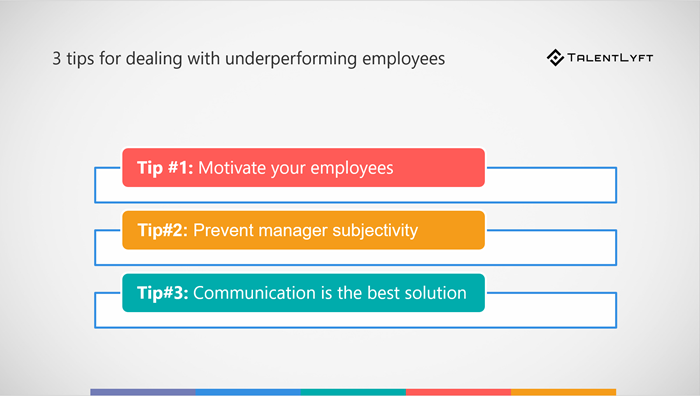
Tip #1: Identify the overarching goal and motivate the employees to reach it
The overarching goal of every business stands above all underlying goals that are part of the daily tasks. As a recruiter, you have multiple underlying goals related to the employees’ attendance, performance, and review processes. Your attendance policies go beyond seeing people sitting at their desks and looking busy. Your performance review goals are not limited to justifying their compensation; they are focused on helping people grow within the organization.
All these goals are geared towards an overarching goal – bringing everyone’s efforts together into a synchronized attempt to achieve the organization’s mission. You should make sure to make that goal part of the office culture. You can remind your employees of it through motivational emails, team building events , and by showing your own example of proper focus and performance.
Tip#2: Prevent manager subjectivity
All managers are doing their best to be objective when reviewing employees. Nevertheless, subjective opinions are blurring our objective assessment of someone else. Maybe you like or dislike a person and there’s nothing you can do about it. Your attitude towards an employee may lead to subjective reviews, which can lead to underperformance.
Taylor Brady, head recruiter for ResumesPlanet, explains:
For me, it’s strange to see many recruiters avoiding standardized employee assessment practices, thinking they can’t downsize an individual to a standardized evaluation form. In reality, standardized assessment is the only prevention from manager subjectivity.
Why is manager subjectivity a problem regarding underperformance? When you’re inclined towards a particular member of the team, you’ll give them an unrealistically positive evaluation. They will figure out they are doing a good job, so you’ll undermine their need to learn more and perform better. When you lack sympathy towards another employee and you give them a slightly more criticizing review than expected, the assessment won’t be motivating to their growth.
That’s why you must stay as objective as possible!
Tip#3: Communication is the best solution
So you noticed that your employee is underperforming? Don’t wait for evaluation time! Have a conversation without delays. As soon as someone is getting lazy or makes a mistake during their work, you should give them momentary feedback. Invite them for a talk in your office and give them recommendations for improvement.
Needless to say, these will be recommendations; not warnings. We don’t have to tell you how to do your job, right? You’ll be honest, but inspiring instead of threatening. A good conversation can be a great remedy when the situation is still fresh.
What if you cannot motivate your underperforming employees?
When it comes to performance management, you have three options:
- Punish underperforming employees with negative evaluations and salary reductions;
- Identify the areas that need improvement and motivate the workers to perform better, or
- Get rid of these workers and hire other people in the company.
Punishments are not the best solution. Instead of motivating your employees, you’re making them frustrated. They will soon start looking for other options and they will leave your company as soon as they get a chance to do that.
Identifying the areas of improvement and encouraging the workers to achieve better performance is always the preferred action to take.
However, it’s not always a final solution. No matter how hard you try to motivate some people, they will not try to give their best. What do you do in that situation?
The ultimate solution for dealing with underperforming employees
Unfortunately, when someone does not fit well into the team and does not meet the expectations, degrading them to a lower position or firing them might be the only options you have left.
At that point, it’s time to start thinking about a more effective hiring process. TalentLyft , a recruitment marketing software and applicant tracking system, makes the hiring process more effective. It helps you find, attract, and hire the best candidates for the position you need to fill in. It will also help you hire the best talent by finding the perfect fit , which will additionally minimize the chance of hiring underperformers.
About the Author
Warren Fowler is a marketing enthusiast and a blogger at ResumesPlanet, who loves music. If he doesn’t have a guitar in his hands, he’s probably embracing new technologies and marketing techniques online! You can meet him on Twitter and Facebook.
Applicant Tracking, Recruitment Marketing, Sourcing and Talent CRM software are powerful alone, but unstoppable when used together!


